Greek vase types
Learn the main ancient Greek vase types—amphora, krater, hydria, kylix, lekythos, and oinochoe—and what each shape was designed to do. This practical guide shows how to identify forms quickly by silhouette, neck, handles, and foot.
Share:
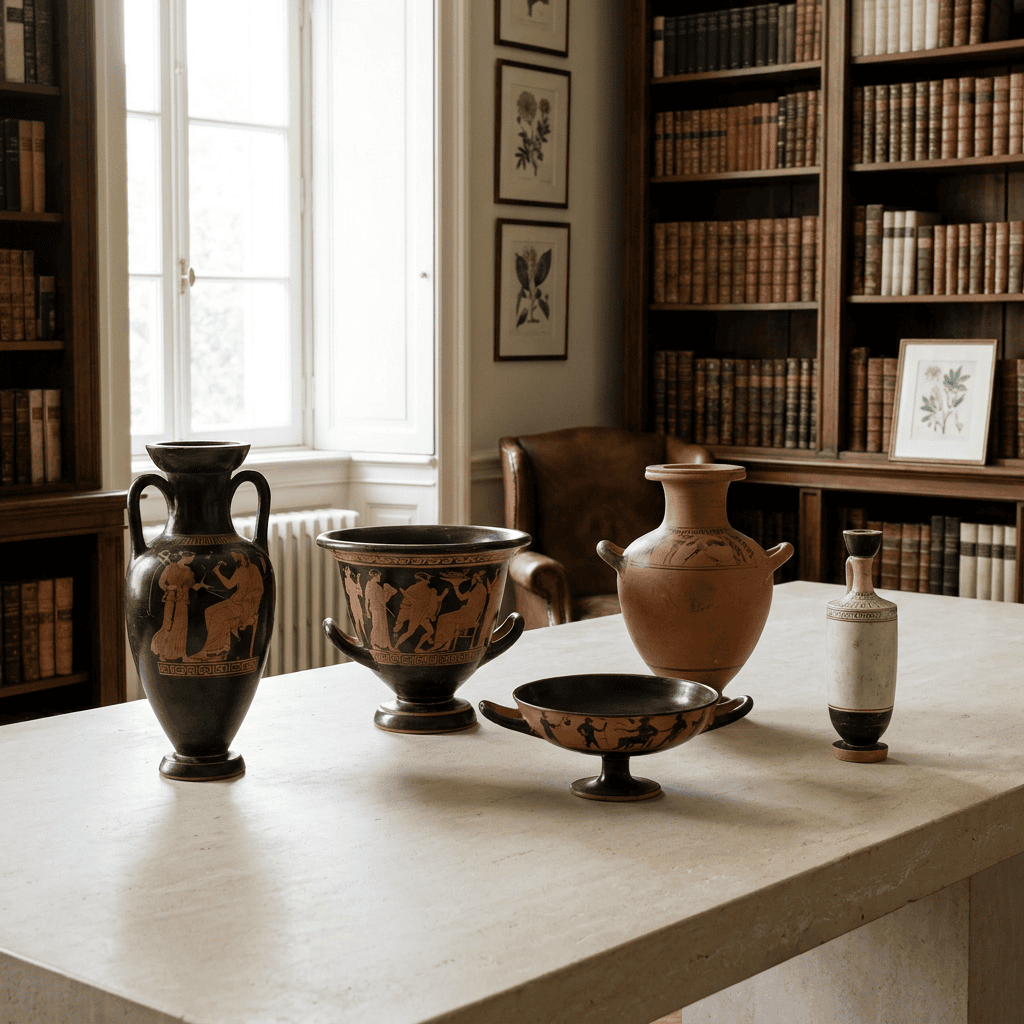
This guide explains the main ancient Greek vase names, the different types of Greek vases you are most likely to encounter, and the uses behind each form. It is designed as a practical reference for readers who want to identify Greek pots accurately, understand their decoration, or choose a historically meaningful replica. To explore examples by shape, visit our Greek vases.
Why ancient Greek pottery came in so many shapes
Ancient Greek pottery was part of daily life, ritual, trade, and social display. Different forms were made for storing grain and liquids, pouring wine, carrying water, offering oils at graves, and drinking during banquets. Shape was not simply decorative. It supported a specific action.
That is why a Greek vase name usually describes a recognizable form rather than a vague category. Handle placement, body width, mouth shape, and foot height all matter. Greek potters developed clear families of vessels, each with its own visual logic and practical use.
A quick guide to common vase names and uses
If you want the fastest overview of types of Greek pots, start here.
| Vase type | How to recognize it | Main use |
|---|---|---|
| Amphora | Tall body, narrow neck, two vertical handles | Storage and transport of wine, oil, or grain |
| Krater | Wide open bowl, often large and heavy | Mixing wine with water |
| Hydria | Rounded body, three handles | Carrying and pouring water |
| Kylix | Broad shallow cup with two horizontal handles | Drinking wine at banquets |
| Lekythos | Slender body, narrow neck, one handle | Holding perfumed oil, often for funerary use |
| Oinochoe | Single handle, pouring mouth, often trefoil shaped | Serving wine |
Major Greek vase types and what each one did
These are the core forms most often discussed in museums, archaeology, and classical art history.
Amphora
The amphora is probably the best-known Greek vase type. It is a two-handled storage jar used for wine, olive oil, grain, and other goods. Because amphorae were both practical and highly visible, they range from plain transport vessels to carefully painted prestige pieces. Their tall body and balanced handles made them easy to lift, seal, and stack. A special ceremonial form, the Panathenaic amphora, was awarded as a prize in Athens and filled with valuable olive oil.
Krater
A krater was the large mixing bowl of the Greek drinking party. Since wine was commonly diluted with water before serving, the krater stood at the center of the symposium and supplied the room. Its scale alone sets it apart from smaller drinking vessels. Major forms include the bell-krater, calyx-krater, column-krater, and volute-krater, each with a different silhouette and handle treatment. If the amphora belongs to storage, the krater belongs to shared social ritual.
Kylix
The kylix is the classic Greek drinking cup: shallow, wide, and set on a stemmed foot with two horizontal handles. Its broad interior gave painters an ideal circular field for a single image, often revealed gradually as the drinker emptied the cup. That theatrical visual effect made the kylix especially suited to the symposium. Among Greek vase types, it is one of the easiest to identify because of its low profile and open, elegant shape.
Hydria
The hydria is a water jar designed with function in mind. It usually has three handles: two horizontal ones for lifting and one vertical handle at the back for pouring. This combination made it practical for carrying water from a fountain and then tipping it into another container. Hydriai appear in domestic scenes, religious settings, and funerary contexts, showing how a strongly functional form could also become an object of painted refinement.
Lekythos
An ancient Greek lekythos is a slim oil flask with a narrow neck, one handle, and a relatively small mouth, ideal for controlled pouring. It held perfumed oil or ointment, but it also became strongly associated with burial practice. Many lekythoi were left at graves or used in funerary rituals, and some of the most delicate examples were decorated in the white-ground technique. This gives the lekythos a special place among Greek vases, combining intimate scale with symbolic meaning.
Oinochoe
The oinochoe is the standard wine jug. It usually has one handle and a pouring mouth, often trefoil shaped, which helps direct the liquid smoothly. After wine was prepared in the krater, it could be ladled or poured into an oinochoe and then served into cups. In other words, the oinochoe sits between the mixing vessel and the drinker. Its importance lies not in size, but in its role within the larger sequence of ancient Greek dining and drinking.
Other Greek pots worth knowing
Beyond the major forms, several other types appear often in collections and reference books.
- Alabastron – a narrow container for perfumed oil, often elongated and easy to suspend or carry.
- Aryballos – a small rounded flask linked especially with athletes, bathing, and body oil.
- Kantharos – a deep drinking cup with high looping handles, frequently associated with Dionysus.
- Pyxis – a lidded container for cosmetics, jewelry, or other small personal items.
- Pelike – a storage jar related to the amphora, but with a softer, fuller lower body.
- Psykter – a vessel used to cool wine, often placed inside a krater filled with cold water.
- Kyathos – a dipper or ladle used for drawing liquid from a larger mixing vessel.
- Kernos – a ritual ring vessel fitted with small cups for offerings.
What the patterns on Greek vases mean
Greek vase decoration was rarely random. Early pottery often uses geometric systems such as meanders, zigzags, triangles, and repeated bands to create order and rhythm across the surface. Later painters developed black-figure vs red-figure, turning the vessel into a place for storytelling as well as ornament.
The imagery often matched context. A drinking cup might show banquets, music, or playful scenes, while a funerary vessel could feature quiet rituals of farewell. Mythological subjects, athletic contests, warriors, gods, and daily life all appear on Greek pottery. These patterns and scenes do more than decorate. They help identify date, region, technique, and sometimes the social world in which the vase was used.
FAQ about Greek vase names
What were Greek vases called?
There was no single ancient label for every Greek vase. Different shapes had different names, including amphora, hydria, kylix, krater, lekythos, and oinochoe. In modern scholarship, these names are used as a practical system for classifying pottery by form and function.
What is the most famous Greek vase?
If you mean a type, the amphora is the most widely recognized Greek vase because it was so common and visually iconic. If you mean an individual object, the François Vase is one of the most famous surviving examples of Archaic Greek painted pottery.
Are Greek pots and Greek vases the same thing?
In everyday English, yes, the terms overlap. Scholars still use the word “vase” for many ceramic forms even when some were really storage jars, flasks, boxes, or mixing bowls rather than flower vases in the modern sense.
How can I identify a Greek vase type quickly?
Start with the silhouette and the handles. Two vertical handles and a tall body usually suggest an amphora, three handles indicate a hydria, a wide open bowl points to a krater, and a shallow footed cup is likely a kylix. Function follows form in Greek pottery.
Greek vase replicas for refined interiors
If a particular form speaks to you, Museum Replicas creates handcrafted, museum-quality reproductions inspired by public-domain classical works. From the strong profile of an amphora to the graceful proportions of a lekythos, each piece can be tailored for a home, library, office, or design project while respecting the history and character of the original tradition. For insight into craftsmanship standards, see how art replicas are crafted. When you’re ready to showcase a piece, explore ways to display museum replicas.
Article details:
- Published by:
- Museum Replicas
- Published to:
- Last modified:
- September 14, 2026
Share:
Continue learning: